Ryzen 9000 & 9000X3D vs Latest Intel: The Ultimate UK Showdown

If you are planning a massive PC upgrade or commissioning a bespoke custom build here in London, you have likely hit the ultimate crossroads: Do you go Team Red (AMD) or Team Blue (Intel)?

The landscape has completely shifted in 2026. AMD has unleashed its Ryzen 9000 series alongside the absolute gaming powerhouse, the Ryzen 9000X3D range (featuring the legendary 3D V-Cache). Meanwhile, Intel has fired back with a massive architectural overhaul in their Core Ultra 200 series (Arrow Lake).

At Geeks Callout, our engineers have been putting these silicon titans through their paces across London—from heavy-duty video editing workstations in Soho to elite gaming rigs in Ealing. Here is our completely unfiltered, constructive breakdown of which processor actually deserves your hard-earned pounds.

1. Performance & The Latest Games: Who Wears the Crown?

When it comes to raw performance, you have to split your workload into two categories: Gaming and Productivity.

  • For the Gamers: There is no point beating around the bush, the AMD Ryzen 7 9800X3D absolutely decimates the competition. AMD’s 3D V-Cache technology stacks extra memory directly onto the chip. In incredibly demanding, CPU-heavy games like Microsoft Flight Simulator, Cyberpunk 2077, or massive multiplayer titles, the 9000X3D provides buttery-smooth frame rates and completely eliminates stuttering. Intel’s latest Core Ultra chips are brilliant, but they simply cannot catch the X3D in sheer gaming frame generation.

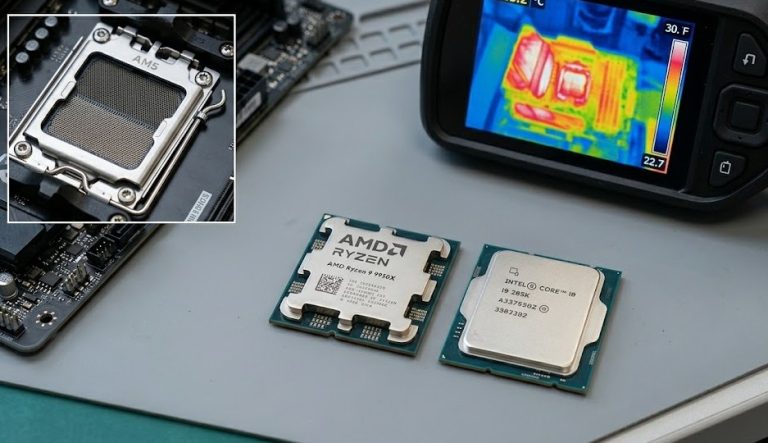
  • For the Creators & Professionals: If you are rendering 4K video, compiling heavy code, or running intensive 3D modelling software, the fight is much closer. The flagship Intel Core Ultra 9 285K and the AMD Ryzen 9 9950X are neck-and-neck. Intel has dramatically improved its multi-threading efficiency, making it an absolute dream for heavy multitasking.

2. Heat & Power Efficiency (Keeping Your Room Cool)

Nobody wants their PC turning their flat into a sauna during a London summer.

Historically, Intel chips ran incredibly hot, gulping down wattage like there was no tomorrow. However, the latest Intel Core Ultra series is a revelation. Intel completely redesigned the architecture, meaning these new chips run substantially cooler and use far less electricity than their 13th and 14th Gen predecessors.

That being said, AMD’s Zen 5 architecture remains the king of efficiency. The Ryzen 9000 and 9000X3D processors can hit their maximum performance targets while drawing remarkably little power, meaning you can get away with a quieter CPU cooler and a smaller power supply.

Winner: A very close draw. Both are incredibly efficient, but AMD still holds a slight edge for keeping thermals ridiculously low.

3. Durability, Lifespan & Future-Proofing

When you drop hundreds of pounds on a processor, you want it to last.

Intel had a rocky few years with degradation and instability issues in their older 13th and 14th Gen chips. The new Core Ultra (Arrow Lake) series completely fixes this with a brand-new socket (LGA 1851) and manufacturing process. It is highly durable, but because the socket is brand new, its future upgrade path remains to be seen.

AMD, on the other hand, is famous for its longevity. The Ryzen 9000 series uses the AM5 socket, which AMD has publicly committed to supporting for years to come. This means if you buy an AM5 motherboard today, you will likely be able to slot in a brand-new processor in 2027 or 2028 without having to rip out your entire motherboard.

Winner: AMD. The AM5 platform offers superior peace of mind and long-term upgradeability.

4. The UK Price Comparison (Value for Money)

Prices fluctuate slightly across UK retailers like Scan, Overclockers, and Amazon, but here is the general state of play:

  • The Heavyweight Creators: AMD Ryzen 9 9950X (approx. £560 – £600) vs Intel Core Ultra 9 285K (approx. £530 – £560). Intel offers incredibly strong value here for productivity workstations.

  • The Gaming Kings: AMD Ryzen 7 9800X3D (approx. £460 – £490) vs Intel Core Ultra 7 265K (approx. £380 – £410).

While Intel is generally pricing its chips slightly more aggressively to win back market share, AMD commands a premium for its X3D chips simply because nothing else can touch them in gaming.

The Final Verdict: Which One Should You Buy?

At Geeks Callout, we don’t believe in a “one-size-fits-all” answer. The true winner depends entirely on what you use your PC for:

The Overall Gaming Winner: AMD Ryzen 9000X3D Series. If your primary goal is pushing the highest possible frame rates, running the latest AAA games flawlessly, and securing the best gaming tech on the market, the Ryzen 7 9800X3D is the undisputed champion. It is the best gaming processor on the planet right now.

The Professional/Productivity Winner: Intel Core Ultra 200 Series. If gaming is secondary and you spend your day rendering video, working in CAD, or pushing heavy productivity apps, Intel has made a brilliant comeback. The Core Ultra chips run cool, offer exceptional multi-core performance, and are priced very competitively.

Need Help Building Your Dream Rig?

Whether you want to construct an unbeatable AMD gaming PC or a silent, high-powered Intel workstation, Geeks Callout is here to help. Our London-based engineers provide expert PC building, upgrading, and laptop repair services right at your doorstep.

Author 's Profile

Picture of Aamir.M

Aamir.M

Aamir Mehmood is a Senior IT Consultant & Technology Writer with over 15+ years of experience and one of the founders of Geeks Callout, an award-winning London-based IT support company specialising in PC, MacBook, and gaming repairs. He is recognised for delivering reliable, customer-focused IT solutions. Under his leadership, Geeks Callout has won multiple honours, including the 2023 Business Excellence Award and the 2025 SME UK Enterprise Award. Aamir also writes insightful articles to simplify complex technology, making him a trusted voice in London’s IT community.